History of Teotihuacan: who built it and why it was abandoned
Teotihuacan was founded about 150 to 100 BCE by a people whose name and language are unknown, held over 100,000 people at its peak of 350 to 550 CE, burned about 550 and was abandoned towards 650 CE.
Who built Teotihuacan?
Who built Teotihuacan about 2,100 years ago has no answer: INAH states that the builders’ name for the city and their language are unknown. The city had about 22 barrios. Those on its edge held merchants from Oaxaca, Michoacán and Veracruz. A 2015 study of ancient DNA from the Teopancazco compound showed a multi-ethnic population in a city of more than 100,000.
The city was neither Aztec nor Maya. The Aztecs arrived in the 13th century and found it abandoned. Maya residents lived in parts of the city, and in 378 CE a leader backed by the city, Sihyaj K’ahk’, entered Tikal. The question page gives you the longer answer.
When was Teotihuacan built?
Teotihuacan was founded about 150 BCE in the chronology of Linda Manzanilla at UNAM, or about 100 BCE in a 2025 Copenhagen study. INAH counts 22 centuries of history.
Growth was fast. The Tzacualli phase, 1 to 150 CE, began with about 8 km² and 20,000 to 40,000 people. By its end the city covered about 20 km² with 60,000 to 80,000 people, in Cowgill’s 1997 estimate.
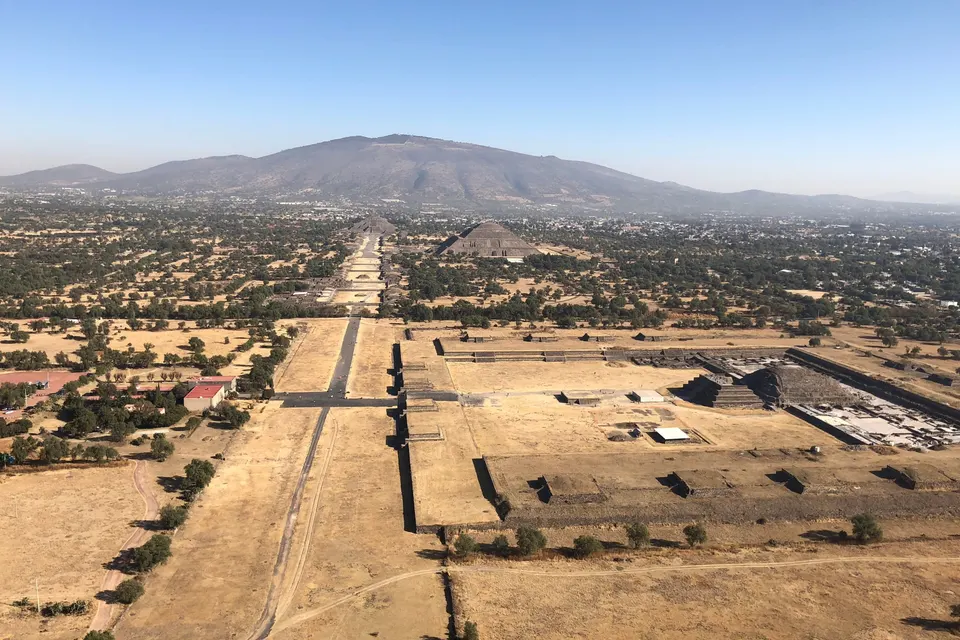
The grid was laid out about 200 CE: the Avenue of the Dead you walk today, the Calzada de los Muertos, and an east-west avenue. INAH dates the Avenue to 150 to 225 CE.
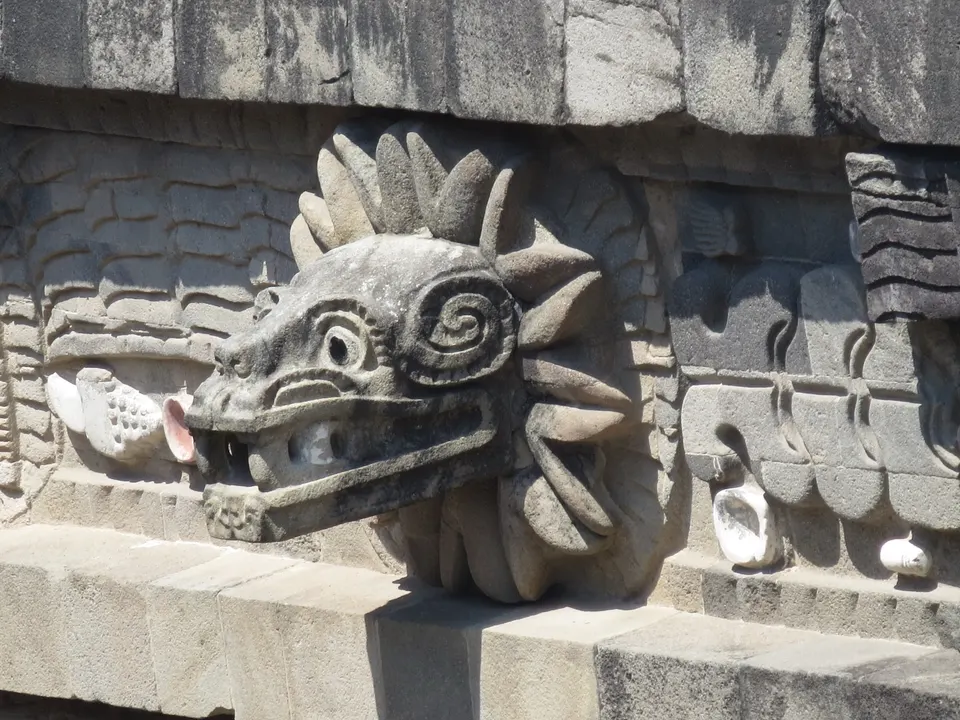
The Pyramid of the Sun dates to 170 to 310 CE, by radiocarbon from the 2008 to 2011 digs. The Temple of the Feathered Serpent went up about 100 to 250 CE. The Pyramid of the Moon has at least seven building stages, from about 100 CE to 650.
What was the city of Teotihuacan like?
At its peak of 350 to 550 CE the city held over 100,000 people on 20 km², in the INAH count. Population estimates range from at least 25,000 in the UNESCO text to 125,000 to 200,000 in Britannica. Area estimates range from 20 km² in Britannica and INAH to 36 km² in UNESCO’s listing, where the ceremonial centre is 10% of the surface.
INAH ranks it the sixth-largest city of the ancient world. The grid you walk runs 15°25’ east of north, towards Cerro Gordo. The builders diverted the San Juan River to cross the Avenue. UNESCO calls the talud-tablero profile the distinctive feature of its buildings.
Grey obsidian came from Otumba and green from the Sierra de las Navajas. Of 111 samples from the Temple of the Feathered Serpent, 79 were Otumba. UNESCO traces its influence as far as Kaminaljuyu in Guatemala. Of its more than 2,000 residential compounds, you can visit Tepantitla with its murals, Tetitla and Atetelco.
Why was Teotihuacan abandoned?
About 550 CE the centre of Teotihuacan burned. A 2023 paper in Radiocarbon dates the Great Fire to 550 CE, give or take 25 years. Dozens of sculptures were smashed. The 1960 to 1964 INAH project found traces of fire inside every monument it explored.
Manzanilla’s 2015 paper in PNAS reads the fire as a revolt against the ruling elite; the site shows no trace of foreign invasion. In a 2025 interview she adds a long drought from about 525 CE. The National Museum of Anthropology lists the other hypotheses: environmental damage, political instability, trade collapse, invasions and epidemics.
The city did not empty at once. About 40,000 people stayed on after the government fell, by a count the 2023 paper cites. UNESCO writes that the city was razed by fire and abandoned towards 650 CE.
What does Teotihuacan mean?
Teotihuacan is a Nahuatl name that the Aztecs gave the ruins around the 1300s; UNESCO translates it as the place where the gods were created. The name you see on the signs is about 700 years younger than the fall of the city.
The Mexica set the birth of the Fifth Sun, a founding myth, in the ruins. They called the Pyramid of the Sun Tonatiuh Itzacual. Sixteenth-century writings say Moctezuma made sacrifices here every 20 days.
The Avenue of the Dead is an Aztec reading too: they took the platforms along it for tombs. Those platforms were palace residences.
Who rediscovered Teotihuacan?
About 1675 Carlos de Sigüenza y Góngora tunnelled into the Pyramid of the Moon, the first archaeological dig in the Americas by a UNAM count. UNESCO dates the first surveys to 1864 and the first excavations to 1884.
An INAH bulletin of 2026 dates the approval of Leopoldo Batres’s project to uncover the Pyramid of the Sun to 1905. In the 1905 to 1910 restoration he added a fifth tier the pyramid never had, in time for the 1910 centenary of Independence. Manuel Gamio excavated the Ciudadela from 1917.
From the gate: Gate 2, Puerta 2 on INAH’s map, 530 m and 7 minutes to the Pyramid of the Sun; the fifth tier you see is his.
INAH seasons began on 11 January 1960 at the Plaza of the Moon. The Proyecto Teotihuacan started on 24 September 1962 with 17 million pesos. It restored 48 building façades along 1,000 m south from the Pyramid of the Moon. The zone you visit opened on 14 September 1964. The Mapping Project of René Millon surveyed 30 km² between 1962 and 1971.
Is Teotihuacan a UNESCO World Heritage site?
Yes: UNESCO inscribed the Pre-Hispanic City of Teotihuacan on the World Heritage List in 1987, under criteria i, ii, iii, iv and vi. They cover its art and size, its influence across Mesoamerica, its urban plan, its ceremonial centre and the Aztec beliefs tied to it. The listing puts it about 50 km north-east of Mexico City.
A decree of 1988 enlarged the protected zone to more than 3,381 ha. The zone you can walk is 264 ha. INAH has coordinated research since 1962.
What has been found at Teotihuacan recently?
On 2 October 2003 a hole opened overnight by the Temple of the Feathered Serpent. It led to a tunnel about 100 m long, sealed about 250 CE. The dig recovered more than 120,000 objects. In 2015 the team found liquid mercury in a chamber.
A 2026 INAH book reports turquoise, the first at the city. You cannot enter the tunnel. If you want the list of finds, the temple page has it.
Under the Pyramid of the Moon a natural cave about 15 m down was detected in 2017 and published in 2020. It was not dug by people. The tunnel under the Pyramid of the Sun, found in 1971, has its own page.
In 2021 the first LiDAR map of the valley recorded 298 new features and 5,795 terraces. A 2025 paper in Current Anthropology proposed that the writing of the city records an early Uto-Aztecan language, an ancestor of Nahuatl. The claim has no independent test yet. Britannica holds that the builders did not speak an Aztecan language. Your MX$210 ticket includes the three site museums.
Tours that stop here
Private Tour: Teotihuacan and Guadalupe Shrine
- MX$210 ticket in the price
Teotihuacán Private Tour: Journey to the City of Gods
- MX$210 ticket in the price
People also ask
Who built Teotihuacan?
Unknown. INAH states that the builders' name for the city and their language are unknown. The population was multi-ethnic: ancient DNA from the Teopancazco compound shows a city of more than 100,000 drawn from several regions, with barrios of people from Oaxaca, Michoacán and Veracruz. It was not Aztec and not Maya, though Maya residents lived there. A 2025 paper proposed an early Uto-Aztecan language for its writing; the claim is untested.
How old is Teotihuacan?
About 2,100 years, counting from a founding date of about 100 BCE; INAH calls it 22 centuries of history, and Linda Manzanilla puts the founding at about 150 BCE. The grid was laid out about 200 CE, the Pyramid of the Sun dates to 170 to 310 CE by radiocarbon, and the peak came in 350 to 550 CE. The city burned about 550 CE and was abandoned towards 650 CE.
Why did Teotihuacan collapse?
The civic centre burned about 550 CE, give or take 25 years by the dates of a 2023 study, and dozens of sculptures were smashed. Linda Manzanilla reads it as a revolt against the ruling elite after a drought from about 525 CE, since the site shows no trace of invasion. The National Museum of Anthropology lists other hypotheses: environmental damage, political instability, trade collapse, invasions and epidemics. About 40,000 people stayed; the city was abandoned towards 650 CE.
Is Teotihuacan older than the Aztecs?
Yes, by more than a thousand years. Teotihuacan was founded about 150 to 100 BCE and abandoned towards 650 CE. Nahua groups arrived in the 13th century, about 700 years after the fall, and found the ruins empty. They gave the site its Nahuatl name, set the myth of the birth of the Fifth Sun there, and Moctezuma made sacrifices at the site every 20 days.
What does Teotihuacan mean?
The place where the gods were created, in the UNESCO translation of the Nahuatl name the Aztecs gave the ruins around the 1300s. Britannica glosses it as the City of the Gods. The builders' own name for the city is unknown. The Mexica called the Pyramid of the Sun Tonatiuh Itzacual, roughly the enclosure of the Sun, and made the ruins the setting of the birth of the Fifth Sun.
Is Teotihuacan a UNESCO site?
Yes. The Pre-Hispanic City of Teotihuacan has been on the World Heritage List since 1987, under criteria i, ii, iii, iv and vi: its art and size, its influence across Mesoamerica, its urban plan, its ceremonial centre and the Aztec beliefs tied to it. A 1988 decree protects more than 3,381 ha; the zone open to visitors is 264 ha. INAH has coordinated research there since 1962.
Sources: Encyclopaedia Britannica · University of Copenhagen news · INAH Boletín No. 110 · Museo Nacional de Antropología · INAH · UC Riverside News · UNAM Global · Manzanilla 2015, PNAS 112(30). Updated 4 November 2026. Found a mistake? Tell us.