The best tour to Teotihuacán from Mexico City
- MX$210 ticket in the price
- shop stop
Option: The best tour to Teotihuacán from Mexico City
fromUS$52.16per person
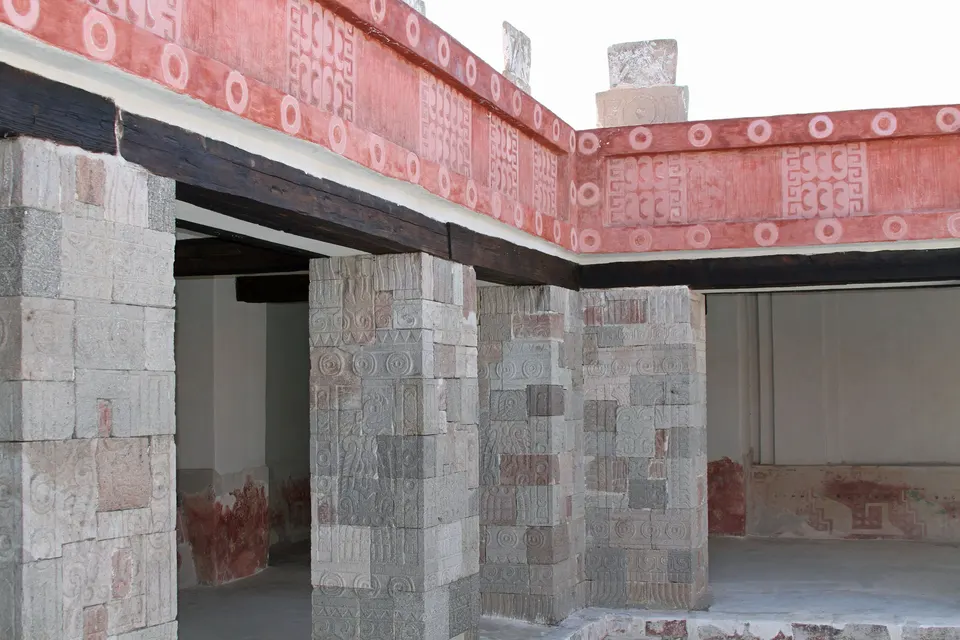
The Palace of Quetzalpapálotl is a rebuilt compound of 450 to 650 CE at the south-west corner of the Plaza of the Moon, 200 m and 3 minutes from Gate 3, with a patio of 9.80 by 8.20 m.
Gate 3200 m · 3 min on foot
The Palace of Quetzalpapálotl, the Palacio de Quetzalpapálotl, was built between 450 and 650 CE at the south-west corner of the Plaza of the Moon. The name joins quetzal and papálotl, butterfly. The pillars of its patio show quetzal birds, face on, with a butterfly on the chest.
The patio measures 9.80 by 8.20 m. Its pillars are carved in low relief with birds in profile and face on. The eyes of the birds are discs of obsidian, still in place. Holes in the pillars held the ties of curtains. The roof merlons carry the Teotihuacan year sign.
The largest serpent head yet found at Teotihuacan came out of this building, with a jaguar sculpture. The compound was an elite residence or an administrative building for rulers or high priests.
Rebuilt in large part: Jorge Acosta excavated and reconstructed the Palace of Quetzalpapálotl in 1962 to 1964, in the Teotihuacan Project. He found signs that the building had burned. Reconstruction was given priority over the dig.
Hundreds of new stones were carved to complete the pillars. Each new stone carries a small incision that marks it as modern. Look for the cuts next to the uncut originals. The roof is a reconstruction. The painted panels are the archaeologist’s reading of murals found in an anteroom.
A conservation project ran from 2009 to 2012. You may not touch or climb the structures, here as in the rest of the zone. Photography for personal use is free.
Behind and below the palace you find two more buildings, the older from the 2nd to 3rd century CE. The Patio of the Jaguars is on a lower level than the palace and of the same period.
The murals of the patio show jaguars with feathers blowing feathered conch-shell trumpets, under a border of rain-god faces. The paintings are on the lower walls. Only parts survive.
The Temple of the Feathered Conches is older. It was raised two or three centuries before the palace and then buried to make room for it. You walk down to the buried level from the jaguar patio.
The temple front carries reliefs of feathered conch shells on the central pilasters and four-petal flowers on the end ones. The platform below is painted with green birds in procession, water streaming from their beaks, on a red-orange ground.
From the gate: Gate 3, Puerta 3 on INAH’s map, 200 m and 3 minutes to the entrance of the Palace of Quetzalpapálotl. The metres and minutes are measured on the map, not an INAH figure.
Gate 3 is the west gate. You buy your ticket at the booth: MX$210 for international visitors and MX$105 with a Mexican ID. Sundays are free for nationals and residents; the tickets page lists the exemptions. Every gate has had bag checks since late April 2026. The toilets are at the entrance.
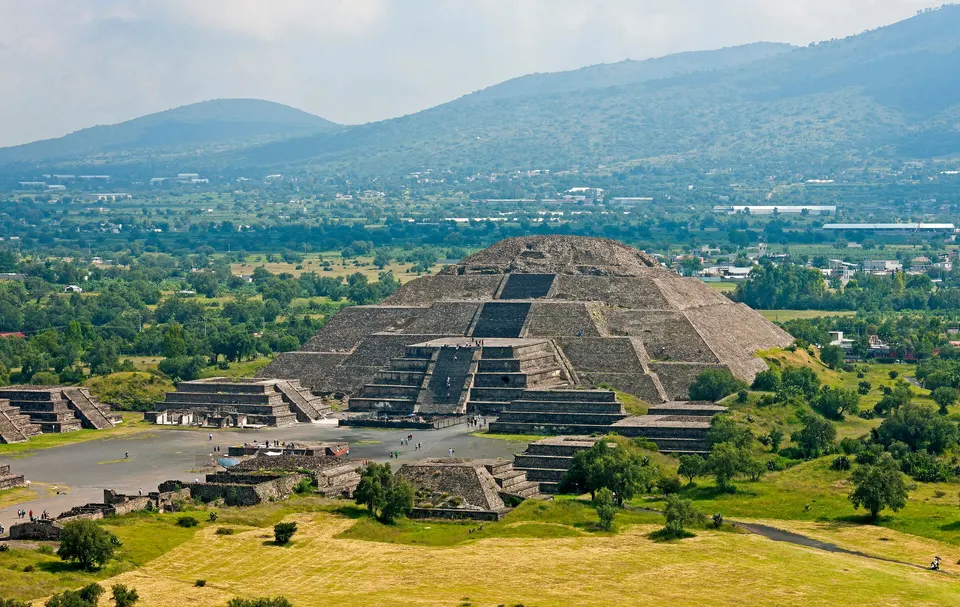
From the gate you pass the palace and reach the Pyramid of the Moon in 530 m and 7 minutes. The Plaza of the Moon is ringed by 13 platforms. The Puma Mural is about 100 m south of the plaza. It is on the east side of the Avenue of the Dead, the Calzada de los Muertos.
If you need step-free access, a ramp is about 500 m along a path from Gate 3, on INAH’s Accessible Trail. INAH’s Family Trail goes in at Gate 3 and out at Gate 5, 1.5 km in 1.5 to 2 hours. The palace is its second stop.
The bus from Terminal del Norte, the Terminal Central de Autobuses del Norte, drops you at Gate 2. The Museum of Teotihuacan Murals is at Gate 3, and your ticket includes it. It opened in 2001 and holds 73 pieces. Hours are 09:00 to 16:00; the museums page has all three.
In the first hour: the gates open at 08:00, and INAH’s advice is to arrive between 08:00 and 09:00. The palace is 3 minutes from Gate 3, so make it your first stop. INAH puts the hottest hours at 11:30 to 15:30. Last entry is 16:30. The zone closes at 17:00.
By the sun: in at Gate 3 at 08:00, the palace and the two buildings behind it before 09:00, the Pyramid of the Moon next. Then 1.0 km and 14 minutes south to the Pyramid of the Sun, before the heat starts at 11:30. Water is sold at entrance 3 and at the Museum of Teotihuacan Culture.
Bring a reusable bottle, sunscreen and a hat. INAH lists Tuesday and Wednesday as the quieter days and tells you to avoid the spring equinox. The best time page has the full answer. The INAH visitor guide gives you the trails and the map.
Quetzal plus papálotl, butterfly: the Palace of the Quetzal Butterfly. The name comes from the reliefs on the patio pillars, which show quetzal birds face on with a butterfly on the chest. The eyes of the birds are discs of obsidian. INAH's map calls the building the Quetzalpapálotl Complex, Conjunto de Quetzalpapálotl; INAH's own pages also use Palace of Quetzalpapálotl. It was built between 450 and 650 CE.
Largely rebuilt. Jorge Acosta excavated and reconstructed it in 1962 to 1964 and gave the reconstruction priority over the dig. Hundreds of new stones were carved for the pillars, each marked with a small incision to tell it from an original. The roof is a reconstruction, and the painted panels are the archaeologist's interpretation of murals found in an anteroom. Conservation work followed in 2009 to 2012.
Gate 3, Puerta 3 on INAH's map: 200 m and 3 minutes on foot, measured on the map. The palace is off the south-west corner of the Plaza of the Moon, and the Pyramid of the Moon is 530 m and 7 minutes from the same gate. The Museum of Teotihuacan Murals, toilets and water for sale are at the entrance. A step-free ramp is about 500 m from Gate 3 along a path.
A patio behind and below the Palace of Quetzalpapálotl, of the same period, with murals of jaguars blowing feathered conch-shell trumpets under a border of rain-god faces. The paintings are on the lower walls and only parts survive. From this patio you walk down to the Temple of the Feathered Conches, a building of the 2nd to 3rd century CE that was buried when the palace was built.
Yes. The MX$210 ticket for international visitors, MX$105 with a Mexican ID, covers the whole archaeological zone and all three site museums, the palace included. There is no separate ticket. Sundays are free for Mexican nationals and foreign residents with proof. The palace is a stop on INAH's Family Trail from Gate 3, 1.5 km and 1.5 to 2 hours, out at Gate 5.
Sources: Arqueología Mexicana · INAH · Lonely Planet · INAH on-site panel 'Complejo Arquitectónico Quetzalpapálotl · INAH Visita Teotihuacán · INAH Lugares · INAH on-site panel 'Mural del Puma' · OpenStreetMap. Updated 4 November 2026. Found a mistake? Tell us.