Teotihuacan, Guadalupe Shrine & Tlatelolco Day Tour with Lunch
- MX$210 ticket in the price
- shop stop
Option: Guided Tour + Ticket, No Lunch
fromUS$41.25per person
Listed by UNESCO in 1987: a city of 20 km² with over 100,000 people at its peak, the 65 m Pyramid of the Sun, a 2 km avenue, more than 366 sculpted heads and 264 ha to walk.
Teotihuacan was a city of 20 km² with over 100,000 people at its peak of 350 to 550 CE. INAH ranks it the sixth-largest city of the ancient world. In the Americas it was the largest. UNESCO listed it in 1987 under five criteria.
Of that city, 264 ha are open to you on foot. The Pyramid of the Sun is about 65 m high. The Avenue of the Dead, the Calzada de los Muertos, is 40 m wide and open for about 2 km. One ticket, MX$210 for international visitors, covers the zone and its three museums. INAH counts almost 2 million visitors a year.
UNESCO inscribed the Pre-Hispanic City of Teotihuacan on the World Heritage List in 1987 under criteria i, ii, iii, iv and vi. Criterion i covers its art and its size. Criterion ii covers its influence across Mesoamerica, as far as Kaminaljuyu in Guatemala. Criteria iii and iv cover the city plan and the ceremonial centre. Criterion vi covers the Aztec beliefs tied to the ruins.
The urban plan is the part you walk on. The grid runs 15°25’ east of north, and the Avenue follows it. A decree of 1988 protects more than 3,381 ha around the 264 ha you can enter. Who built the city and why it burned is on the history page.
The zone open to visitors is 264 ha, out of a city that reached 20 km² at its peak. The UNESCO text gives 36 km² for the urban area, with the ceremonial centre at 10% of it. More than 2,000 residential compounds stood on that ground.
The Avenue of the Dead was about 5 km long. The 2 km you can walk run from the Ciudadela to the Plaza of the Moon and rise 27 m. The Ciudadela alone is 400 m per side.
The INAH trail that covers the whole zone is 5 to 6 km and 4 to 5 hours. INAH recommends 3 to 5 hours for your visit. The tickets page has the hours; the best tours are listed by what the price buys.
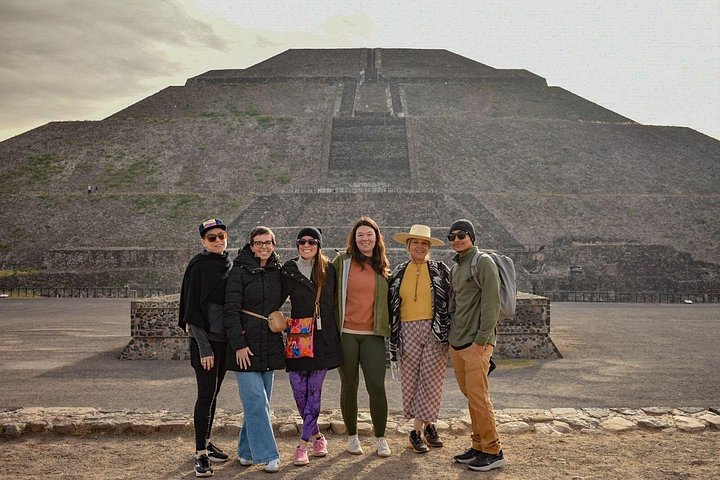
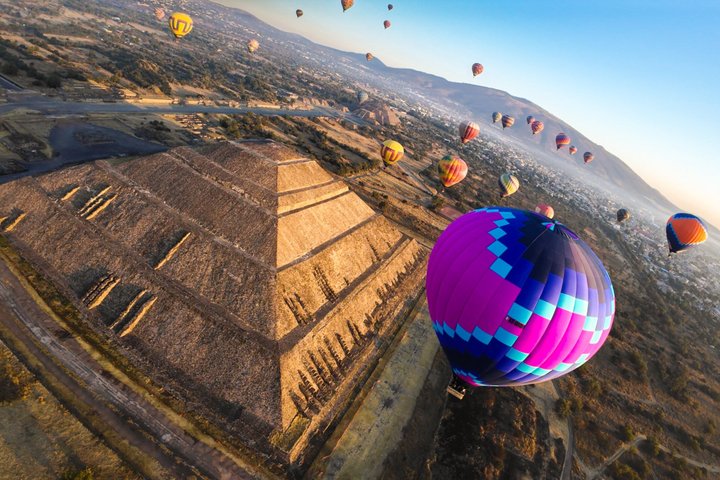
The Pyramid of the Sun is about 65 m high on a base of 222 by 225 m, the largest structure in the city. Radiocarbon dates from the 2008 to 2011 excavations put it at 170 to 310 CE. Its west face marks the sunsets of 30 April and 13 August, 260 days apart.
Under it runs a tunnel 103 m long, found in 1971 and older than the pyramid. The west stairway has 248 steps and has been closed since 2020. You can stand at its foot. The tunnel page has the finds.
From the gate: Gate 2, Puerta 2 on INAH’s map, 530 m and 7 minutes to the Pyramid of the Sun, measured on the map.
More than 366 sculpted heads once covered the four sides of the Temple of the Feathered Serpent. INAH calls it the only building in the city with a façade formed by stone sculpture, and the paint still shows. The heads on the west side are the originals, in place, because a platform covered them about 350 CE. Four of the seven tiers stand today.
Under the temple a tunnel about 100 m long opened on 2 October 2003. The dig recovered more than 120,000 objects, the largest collection from a single excavated context at the site. The tunnel is closed to the public. You find the temple inside the Ciudadela, at the south end of the Avenue.
For its size. At its peak of 350 to 550 CE it was the largest city in the Americas, with over 100,000 people on 20 km², the sixth-largest city of the ancient world by the INAH count. UNESCO listed it in 1987. The Pyramid of the Sun is about 65 m high, the Avenue of the Dead is open for about 2 km, and almost 2 million people visit each year, about 50 km from Mexico City.
The Pyramid of the Sun: about 65 m high on a base of 222 by 225 m, on the east side of the Avenue of the Dead, 530 m and 7 minutes from Gate 2. The Pyramid of the Moon, 45 m high on 140 by 150 m, is the second-largest monument. The Temple of the Feathered Serpent is the third, with more than 366 sculpted heads. Climbing the Pyramid of the Sun has not been allowed since 2020.
Over 100,000 at its peak of 350 to 550 CE, by the INAH count, in more than 2,000 residential compounds on 20 km². The estimates differ by source: Britannica gives 125,000 to 200,000 about 500 CE, Cowgill's middle estimate is 125,000, a 2023 radiocarbon study gives 85,000 to 125,000 by 200 CE, and the UNESCO text gives at least 25,000. INAH ranks it the sixth-largest city of the ancient world.
The main axis of the city, the Calzada de los Muertos: 40 m wide, about 5 km long, and open to you for about 2 km from the Ciudadela to the Plaza of the Moon. It rises 27 m from south to north and follows the city grid, 15°25' east of north. INAH dates its layout to 150 to 225 CE. The name is Aztec: they took the platforms along it for tombs. The platforms were palace residences.
Sources: INAH · UNESCO World Heritage Centre · Encyclopaedia Britannica · FAMSI report 2007 · Buckley et al. 2023, Radiocarbon 65(3):617–641 · UC Riverside News · Šprajc 2000, Astronomical Alignments at Teotihuacan, Latin American Antiquity 11(4) · Arqueología Mexicana. Updated 4 November 2026. Found a mistake? Tell us.